

School life is uniquely exciting, formative, and full of social and academic opportunities. But for many, it can come with quiet stressors like academic pressure, financial stress, and the challenges of newfound independence.
If you are a student struggling to keep up, or you are concerned about a loved one who is struggling to adjust to the expectations of high school or college life, know you are not alone.
Brain-Body Therapy exists to help its users regulate their minds through exercise. Created by a mental health professional and a fitness consultant, Brain-Body Therapy aims to create holistic wellbeing through an integration of mental and physical wellness tools.
When structured correctly, exercise is not just a pathway for physical fitness but an essential component of mental well-being. Here, we will break down how exercise for academic stress works, which workouts are most effective, and how Brain-Body Therapy turns therapeutic exercise into a practical, accessible system for high school and college students to manage stress and anxiety and avoid burnout.
Key Takeaways
- Chronic academic stress keeps cortisol elevated, disrupting focus, sleep, motivation, and emotional regulation. Exercise is one of the most effective physiological tools for breaking this cycle.
- Cardio clears mental load and stress hormones and strength training rebuilds confidence and a sense of control during unpredictable academic periods.
- Brain-Body Therapy offers quick, structured, at-home workout programs tailored to academic stress, anxiety, and depression with no gym access or lengthy time commitment required.
Why Academic Stress Becomes a Mental Health Issue
Stress is often treated as something students are supposed to push through, but when stress is constant, the body enters a state of physiological activation that can be detrimental when prolonged and left unaddressed.
The stress response in the body, known as cortisol, is designed to be a short-term chemical release. When the stress system is switched on for extended periods of time, the brain and body face consequences.
Over time, heightened cortisol levels can cause:
- Difficulty focusing or retaining information
- Emotional exhaustion or irritability
- Sleep disruption
- Physical tension and fatigue
- Reduced motivation and increased avoidance
Exercise is an essential component in the stress cycle. Without a physical release, the body will have a harder time regulating and returning to a healthy base level. By this logic, exercise is not just encouraged for fitness but is an essential physiological component of stress management.
Left unaddressed, this chronic stress response can also contribute to anxiety in teens and young adults, extending well beyond the classroom.
How Exercise Changes the Stressed Brain
Exercise directly influences the same systems that are disrupted by chronic stress.
When the body moves, it helps regulate the overactivation of the stress response, particularly hormones like cortisol and adrenaline. Instead of accumulating in the system, these stress chemicals are metabolized and cleared more efficiently.
At the same time, exercise increases key neurochemicals involved in mental health
- Endorphins reduce perceived stress and discomfort
- Serotonin supports emotional stability
- Dopamine improves motivation, focus, and reward processing
Even short bouts of movement can shift how a student feels mentally within minutes. Research consistently shows that regular exercise in school students is associated with lower academic stress levels, improved sleep quality, and better emotional regulation under pressure. Students who exercise regularly also report stronger cognitive control and focus during demanding tasks.
Best Exercise Modalities for Academic Stress
Different types of movement produce different neurological and psychological effects. Brain-Body Therapy is designed to help users match exercise styles to specific stress patterns.
Yoga and Mindful Movement: Downregulating the Nervous System
Yoga is one of the most effective tools for calming an overactivated central nervous system. It works by combining slow controlled movement, regulated breathing exercises, and present-moment awareness to calm the body and mind.
For students, yoga can be effective in reducing the physical symptoms of academic stress, including body tension, breathing patterns, and restlessness.
Even short sessions between study blocks can help reset the nervous system and restore a sense of calm control. Yoga is especially useful for students experiencing difficulty winding down after studying.
Cardio and Aerobic Exercise: Clearing Mental Load
Aerobic exercise is one of the most well-researched interventions for stress regulation. Cardio is not only great for physical well-being, but is also known to reduce stress hormones by increasing blood flow and oxygenation to the brain. Brain-Body Therapy workout plans incorporate regular cardio for reducing stress and the related anxiety symptoms.
Aerobic exercise is an effective tool for mental clearing because it temporarily shifts focus away from stressors and into physical rhythm. Something as simple as a 20-minute walk between classes can function as a full nervous system reset.
From a Brain-Body Therapy perspective, cardio is not about endurance, but about interrupting stress loops before they become all-consuming.
Strength Training: Rebuilding Control and Confidence
Strength training plays a unique psychological role in stress management. Unlike passive stress relief strategies, strength training provides immediate feedback through measurable progress benchmarks.
For students struggling with acclimating to college lifestyle, strength training can provide a structured, controllable system in contrast to the unpredictability and inconsistency of their environment.
For students, finding a semblance of control can be particularly important. Academic stress often creates a sense of helplessness, indicating that one’s effort does not always translate into success.
Strength training reverses that pattern by reinforcing a clear relationship between effort and outcome. Over time, this can improve not only physical resilience but also psychological confidence.
Building a Sustainable Exercise Routine During High School & College
When it comes to fitness for stress management, the most effective strategy is not intensity, but consistency. For many students, time is a limiting factor and regularly cited stressor. However, it is a misconception that abundant free time is essential for an effective fitness routine.
Making Exercise Work in a Limited Schedule
Students often assume they need long workouts to see benefits, but in reality, 20–30 minutes of structured movement a few times per week is enough to produce measurable changes in stress and mood regulation.
Movement can be easily integrated into existing routines. Simple changes like walking to class instead of relying on university transportation, or taking stairs instead of elevators, can have a sizable impact. Many students also see success when they integrate small bursts of fitness into study sessions.
This reduces friction and removes the all-or-nothing barrier that prevents consistency. Sedentary school schedules(hours at a desk, then hours more studying) are one of the biggest hidden contributors to student stress and low mood.
Brain-Body Therapy is designed specifically for the reality that time is a limited commodity. That’s what our platform is dedicated to delivering: guided, at-home workouts that fit directly into your schedule without requiring gym access or complex planning.
Exercising With Others: Social Regulation of Stress
Exercise can be even more effective when it includes social connection. Working out with friends or classmates helps to reduce isolation during high-stress academic periods and improve accountability and consistency.
For many students, social exercise is what keeps routines stable during exam periods, when motivation naturally declines. This combination of movement and connection has a compounding effect on stress regulation.
Exercise, Sleep, and Academic Recovery
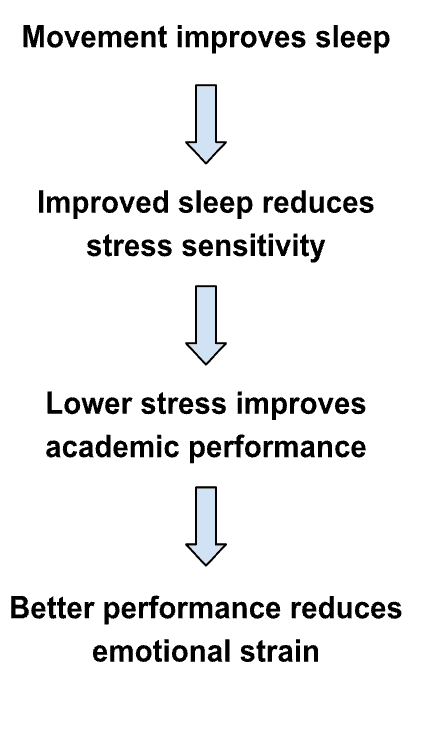
Sleep disruption is one of the most frequent and consequential results of academic stress.
Exercise supports sleep by reducing excess stress hormone levels in the evening. This can make falling asleep easier and improve both sleep depth and continuity. Sleep is an essential tool in regulating circadian rhythm stability, which directly informs stress levels.
This creates a reinforcing cycle
Brain-Body Therapy’s Clinical Approach to Academic Stress
Brain-Body Therapy was created to bridge a gap in mental health care and bridge the disconnect between physical activity and clinical mental health treatment.
The mission of Brain-Body Therapy is to integrate both disciplines into a unified system and ultimately regulate the brain through structured movement. Unlike traditional workout plans, Brain-Body Therapy programs are built around psychological and physiological stress profiles.
For students experiencing academic stress, anxiety, or depressive symptoms, programs are tailored to target stress directly with quick, manageable workouts for all skill-levels, even with a busy school schedule and/or a sedentary lifestyle.
This ensures that movement is accessible even for students who feel overwhelmed, fatigued, or disconnected from motivation.
Progressive Movement for Long-Term Mental Resilience
Throughout the program, workouts targeting anxiety and depression continuously evolve and include a combination of
- Strength training for stability and confidence
- Cardio for stress hormone regulation
- Yoga and mobility for nervous system recovery
- Integrated recovery practices for emotional balance
This progression supports long-term adaptation, built with the intention of helping students build resilience and routine rather than short-term, unsustainable relief.
Moving Forward: Reclaiming Control Through Movement
Academic stress can make students feel like they are acting reactively and never fully in control of their time, energy, or emotions.
Though movement will not eliminate the stressors of college and academia entirely, it can help interrupt the cycle and physiological impacts of stress in the body. Regular exercise restores regulation, improves clarity, and rebuilds the connection between effort and outcome.
Brain-Body Therapy exists to make that process structured, accessible, and clinically informed so that students are not guessing how to feel better, but following a system designed to help them get there.
In addition to schools and universities, Brain-Body Therapy also works with mental health practices, businesses, and local communities.
Academic Stress Management FAQs
How does exercise reduce academic stress in the brain and body?
Exercise helps regulate stress hormones while increasing neurotransmitters like serotonin and dopamine, improving emotional stability, focus, and stress tolerance.
What are the best workouts for academic stress?
Yoga, cardio, and strength training are the most effective because they each target different aspects of nervous system regulation, emotional balance, and psychological resilience.
Can yoga or stretching really help with stress from studying?
Yes. Yoga and stretching reduce physical tension from prolonged studying and help regulate the nervous system, making it easier to relax and recover.
How do I fit exercise into a busy college schedule?
Short, consistent sessions combined with everyday movement like walking or stairs are often enough to produce meaningful stress-relief benefits.
Does exercising with friends make a difference?
Yes. Social exercise improves consistency, reduces isolation, and provides accountability, especially during high-pressure academic periods.
How does exercise affect sleep and stress?
Exercise improves sleep quality by regulating stress hormones and stabilizing sleep cycles, which helps reduce overall academic stress levels.
Can students with no experience start a Brain-Body Therapy program?
Yes. Students can start with Brain-Body Therapy’s anxiety program, which is designed to be accessible for beginners and gradually progress based on comfort, energy, and stress levels.
How can schools or universities support students using Brain-Body Therapy?
They can use Brain-Body Therapy’s structured movement approach to support students at home or integrate it into campus wellness initiatives aimed at improving student mental health outcomes. Students can opt into sharing their workout data with the university, allowing schools get direct access to their user data with permission.
Related Exercise & Mental Health Blogs